... ... Adam Smith: июля 2018

воскресенье, 22 июля 2018 г.

Economic growth


Smith’s explanation of economic growth , although not neatly assembled in one part of The Wealth of Nations, is quite clear. The score of it lies in his emphasis on the division of labour (itself an outgrowth of the “natural” propensity to trade) as the source of society’s capacity to increase its productivity.
The Wealth of Nations opens with a famous passage describing a pin factory in which 10 persons, by specialising in various tasks, turn out 48,000 pins a day, compared with the few, perhaps only 1 , that each could have produced alone. But this all-important division of labour does not take place unaided.

Society and “the invisible hand”


The theory of historical evolution, although it is perhaps the binding conception of The Wealth of Nations, is subordinated within the work itself to a detailed description of how the “invisible hand” actually operates within the commercial, or final, stage of society. This becomes the focus of Books I and II. In which Smith undertakes to elucidate two questions. The first is how a system of perfect liberty, operating under the drives and constraints of human nature and intelligently designed institutions , will give rise to an orderly society.
The question, which had already been considerably elucidated by earlier writers, required both an explanation of the

The Wealth of Nations


Despite its renown as the first great work in political economy. The Wealth of Nations is in fact a continuation of the philosophical theme begun in The Theory of Moral Sentiments. The ultimate problem to which Smith addresses himself is how the inner struggle between the passions and the “impartial spectator’ - explicated in Moral Sentiments in terms of the single individual - works its effects in the larger arena of history itself, both in the long-run evolution of society and in terms of the immediate characteristics of the stage of history typical of Smith’s own day.
The answer to this problem enters in Book 5, in which Smith outlines he four main stages of organization through which

Travels on the Continent


The Theory quickly brought Smith wide esteem and in particular attracted the attention of Charles Townshend, himself something of an amateur economist, a considerable wit, and somewhat less of a statesman, whose fate it was to be the chancellor of the exchequer responsible for the measures of taxation that ultimately provoked the American Revolution. Townshend had recently married and was searching for a tutor for his stepson and

The Theory of Moral Sentiments


In 1759 Smith Published his first work, The Theory of Moral Sentiments. Didactic, exhortative, and analytic by turns, The Theory lays the psychological foundation on which The Wealth of Nations was later to be built. In it Smith described the principles of “human nature “, which, together with Hume and the other leading philosophers of his time, he took as a universal and unchanging datum from which social institutions, as well as social behaviour, could be deduced.
One question in particular interested Smith in The Theory of Moral Sentiments. This was a problem that had attracted Smith’s teacher Hutcheson and a number of Scottish philosophers before him. The question was the source of the ability to form moral judgements, including judgements on one’s own behaviour, in the face of the seemingly overriding passions for self-preservation and self-interest.

Glasgow


Smith then entered upon a period of extraordinary creativity, combined with a social and intellectual life that he afterward described as “ by far the happiest, and most honourable period of my life”. During the week he lectured daily from 7:30 to 8:30 am and again thrice weekly from 11 am to noon, to classes of up to 90 students, aged 14 and 16. (Although his lectures were presented in English, following the precedent of Hutcheson, rather than in Latin, the level of sophistication for so young an audience today strikes one as extraordinarily demanding.) Afternoons

Early Life


Unfortunately, much is known about Smith’s thought than about his life. Though the exact date of his birth is unknown, he was baptised on June 5, 1723, in Kikcaldy, a small (population 1,500) but thriving fishing village near Edinburgh, the son by second marriage of Adam Smith, comptroller of customs at Kikcaldy, and Margaret Douglas, daughter of a substantial landowner. Of Smith’s childhood nothing is known other than that he received his elementary schooling in Kirkcaldy and that at the age of four years he was said to have been carried off by gypsies.

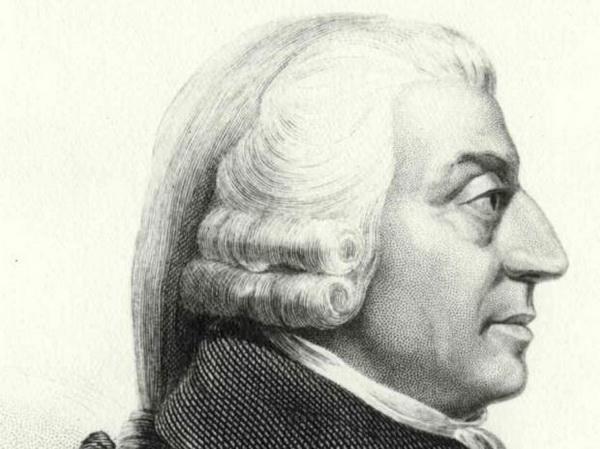
Adam Smith

After two centuries, Adam Smith remains a towering figure in the history of economic thought. Known primarily for a single work, An Inquiry into the nature an causes of the Wealth of Nations (1776), the first comprehensive system of political economy, Smith is more properly regarded as a social philosopher whose economic writings constitute only the capstone to an overarching view of political and social evolution.

The few facts of his life

On July 17, 1790, at the age of 67, full of honours and recognition, Smith died; he was buried in the churchyard at Canongate with a simp...